Wavestation Update
In the process of refurbishing a Wavestation, I needed to find a replacement UK power supply. As one hadn’t came up on the market recently, I ended up designing a carrier board for a commonly available switching power supply.
If you have replaced your electro-luminescent display with an LCD that runs from the digital power rail, and you’re comfortable with some assembly, the details are over here.
Modal Electronics
Modal Electronics make the Cobalt8, Argon8 and Carbon8 synthesizers. Well-made, quite heavy, mostly metal construction.
Each synthesizer has a two-axis joystick used for modulation and pitch-bending, and they just so happen to be terribly prone to breaking in various ways in shipping. This is a major problem because Modal themselves do not supply spare parts.
The most common issue seems to be the stick jumping out of the metal guides, which can typically be fixed with a little bit of force. Second to that would be the springs used to centre the stick jumping out of their hooks.
Anyway - while Modal don't specify this anywhere, the joystick is in fact made by Tsubame Radio Co. If you look hard enough, you can actually see the Cobalt8 on their examples page. Anyone with minimal soldering ability shouldn't have any issues swapping their stick out.
The part name is TX-26PRR. You can find it on eBay.
Korg Wavestation
I bought a Korg Wavestation. Fantastic synthesizer from the 1990's focusing on 'wave sequencing'. Wave sequencing itself being new at the time, and best described as muxing samples (waves) in a sequenced manner, with a vector joystick used to manipulate the mix of said waves.
Interestingly, Korg followed up the Wavestation very quickly with the 'Wavestation EX'. The Wavestaton EX is in fact just the original Wavestation, but with four extra ROMs containing additional samples. And an 'EX' sticker - which explains why photographs online regularly show the location of the 'EX' differing.
In practice, any Wavestation can be a Wavestation EX, provided you're willing to solder the DIP ROMs (and potentially swap out the OS chips, if your Wavestation isn't on the latest OS versions).
Here's my Wavestation's board, prior to the modification. You'll see the four unpopulated, slots for the EX ROMs to the left. I've since added those ROMs, but forgot to take a picture - d'oh:
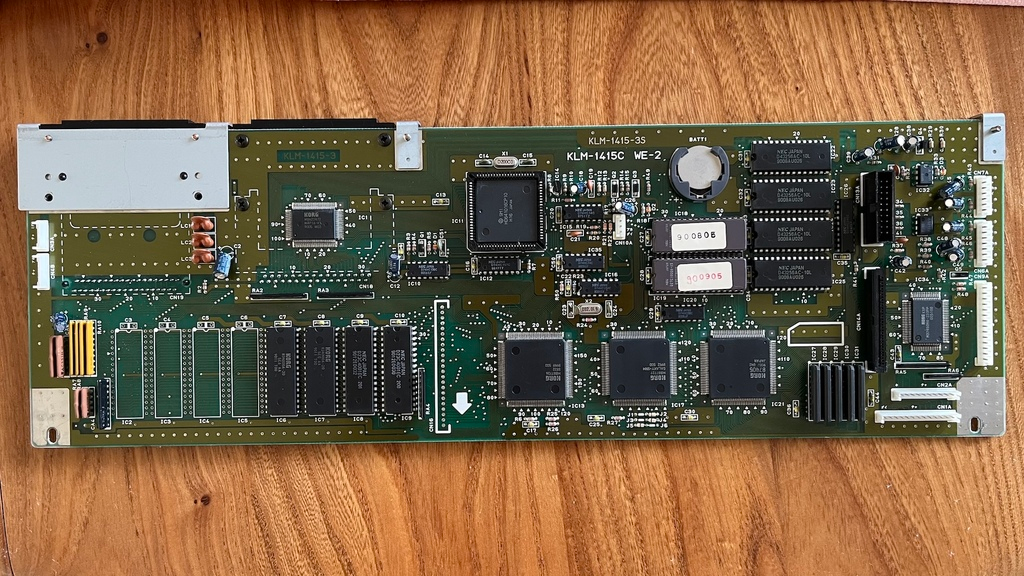
Wavestation WS-1 Prior to EX Upgrade
The upgrade is trivial, and the internals of the synth itself are very well arranged.
Advice: scuff up the legs of the chips you’re adding with a fibreglass pen (or very fine sandpaper). They’ll likely be heavily oxidised, and flux isn’t going to be enough to to get the solder to stick.
Disassembly only requires a philips screwdriver, and components prone to death-by-old-age are through-hole making maintenance much easier.
One common issue with old Wavestations is the display backlight, which is electroluminescent. Quite similar to certain Casio watches, and a rather nice teal colour.
Sadly these tend to fail with age, and while you can replace just the backlight, for the time it takes, you might as well replace the display entirely, which is what I opted to do:
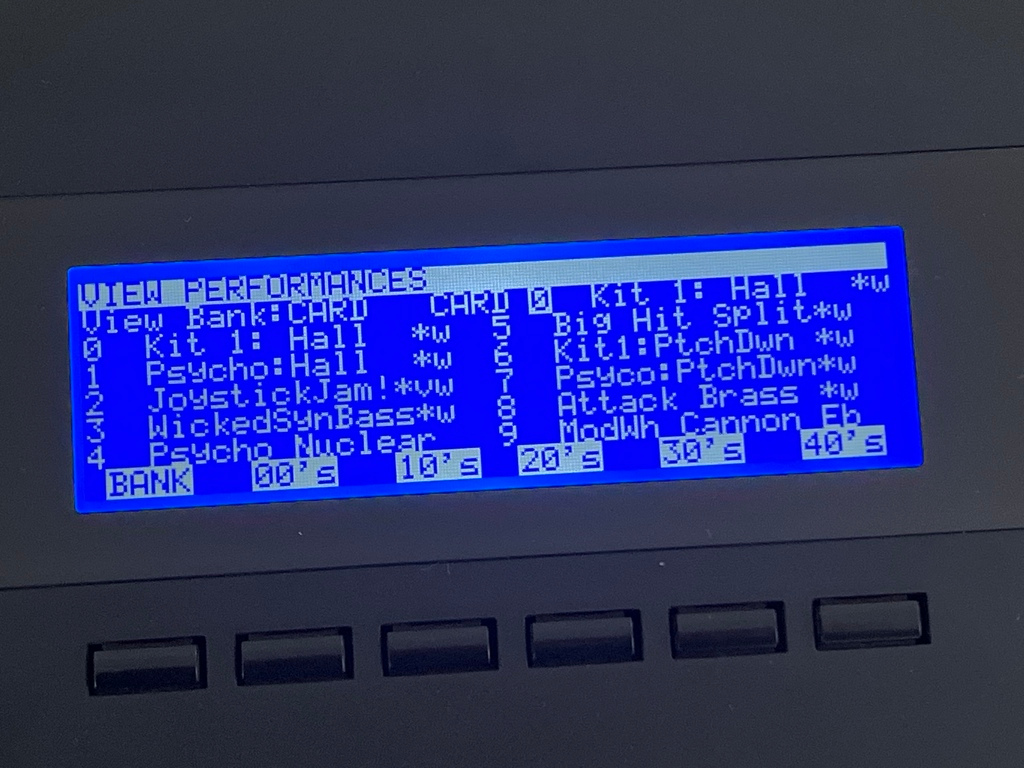
A Contemporary Backlit LCD Display
The replacement display board was purched from Saint Baz on eBay UK. Fantastic guy, and a fantastic board. Unlike most other replacement displays you'll find online, it really is a drop-in replacement. Take out the mainboard, detach the keybed, disconnect and unscrew the old display, then drop in and connect up the new.
Wavestation Performances
The Wavestation, while fantastic, is from the 1990s. The concept of removable storage at the time, at least on a product like this, was novel.
As a result, performance (an arrangement of patches with effects) and patch (a collation of waves/samples with modifications like pitch) management on the Wavetstation is a bit wonky.
The storage on the Wavestation is arranged as such:
| Bank | Max Performances | Writeable | Internal |
|-------|------------------|-----------|----------|
| ROM | 49 | No | Yes |
| RAM 1 | 49 | Yes | Yes |
| RAM 2 | 49 | Yes | Yes |
| RAM 3 | 49 | Yes | No |
The ROM contains 49 performances, and RAM 1 and 2 contain another 49. Importantly, the performances stored in RAM 1 and 2 are backed by a CR2032 coin battery.
If you have bought a Wavestation, and RAM 1 and 2 simply contain the performances found in the ROM bank, your battery is likely dead, or the previous owner initialised RAM 1 and 2 through the service menu.
The performances originally found in RAM 1 and RAM 2 are contained in factory.zip. You can find it around online, or you can contact me and I’ll be able to share it.
RAM 3 is special, in that it isn't RAM installed in the Wavestation. This point wasn't immediately obvious to me, and you can be forgiven for thinking a third RAM bank is indicative of a Wavestation EX.
Quite a few people seem to get this wrong, and it confused me too. RAM 3 is a card that came with the Wavestation EX, and made use of the performances found in the four additional ROMs the Wavestation EX had installed. These cards are rather expensive these days, and I believe they also use a coin cell to retain data - any you find are likely to be dead.
But I could be wrong.
You don't need RAM 3 to make use of the Wavestation EX sounds, as you can recreate the performances yourself using the Wavestation's controls.
But if you would rather not do that, you can also write the sysex within factory3.zip to RAM 1. Although some of the original performances in RAM 1 and 2 reference patches on the other card - which means writing a copy of RAM 3 to RAM 1 will potentially mess with some of the performances in RAM 2.
A better option, if you're willing to pay, is to purchase a modern aftermarket card such as those made by m1RAM. Even if you don't have a Wavestation EX, it's worth having a card like this because without it you'll need to erase factory performances in order to save your own.
As a final note - do be aware that Korg sold not only RAM cards for the Wavestation, but also PCM cards. These cards have a different edge connector altogether, and contain samples.
If you see something like the WPC-02 "DRUMS & PERCUSSIONS" card online, it will only work if you also have the WSC-02 PCM DATA card containing the relevent samples. WaveReX make a rewritable PCM card, which when used in conjunction with the m1RAM card unlocks access to everything (albeit with some work).